
How Habits Really Work: The 4-Step Habit Loop
Why is it so easy to pick up your phone without thinking, and so hard to start a workout you've promised yourself ten times?
The answer isn't willpower. Every habit, good or bad, follows the same pattern. Once you can see it, you can start changing your habits on purpose.
The habit loop
In Atomic Habits, James Clear describes every habit as a loop of four steps:
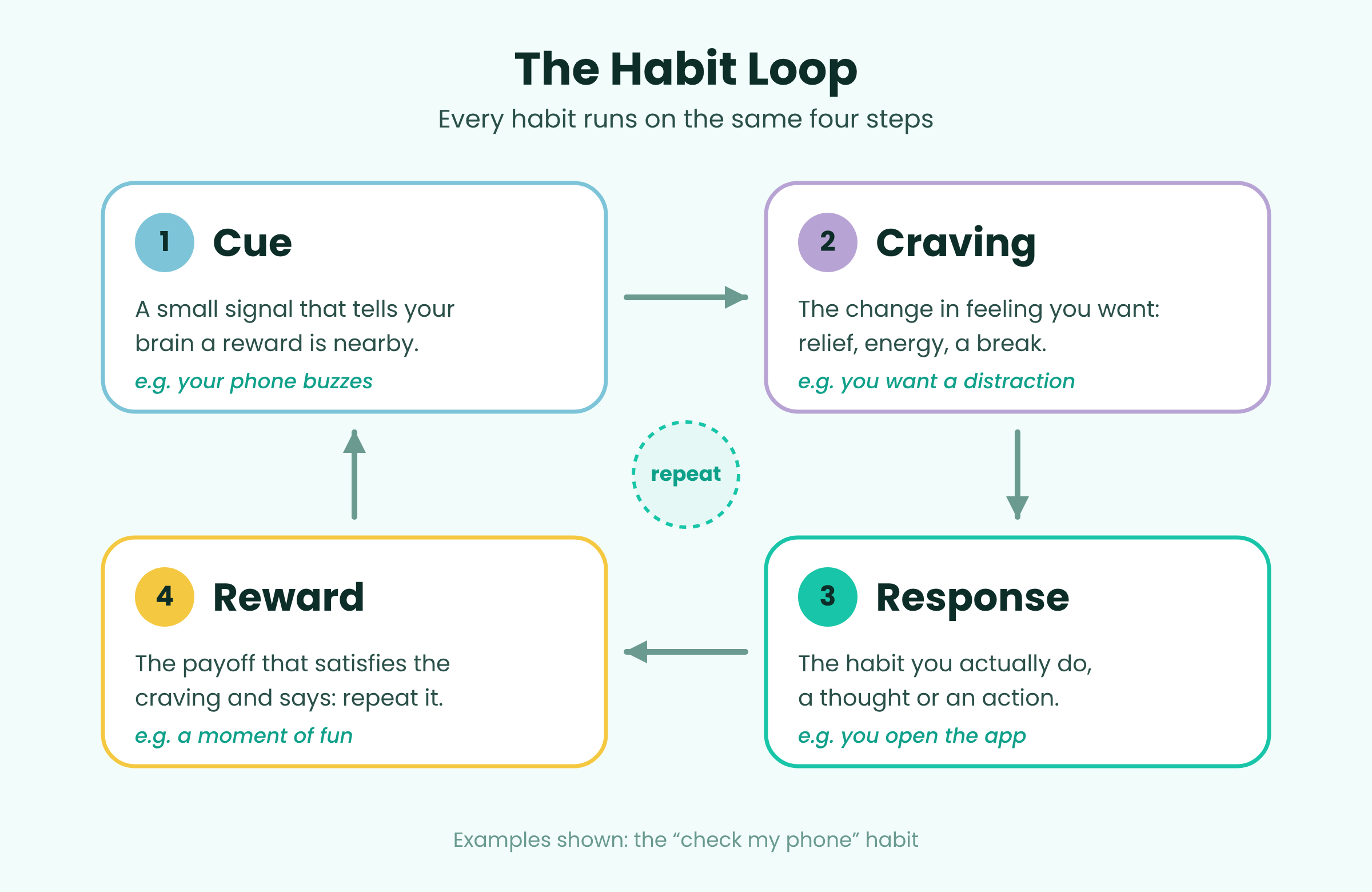
Cue is the trigger. It's a small signal that tells your brain a reward is nearby: a time of day, a place, a feeling, a notification.
Craving is the motivation behind the habit. You don't crave the habit itself, you crave the change in how you feel afterwards: relief, energy, comfort, a break from boredom.
Response is the habit you actually do. It could be a thought or an action, and it only happens if it's easy enough and you're motivated enough.
Reward is what you get at the end. It satisfies the craving and teaches your brain to repeat the loop next time.
Same loop, different habit
Take scrolling on your phone. You feel a little bored (cue), you want a quick distraction (craving), you open an app (response), and you feel entertained for a moment (reward). None of this takes effort or planning, which is why it feels automatic.
Now take reading 10 pages a day. You sit on the bus and the book is right there (cue), you want to feel calm (craving), you read (response), and you feel a sense of progress (reward).
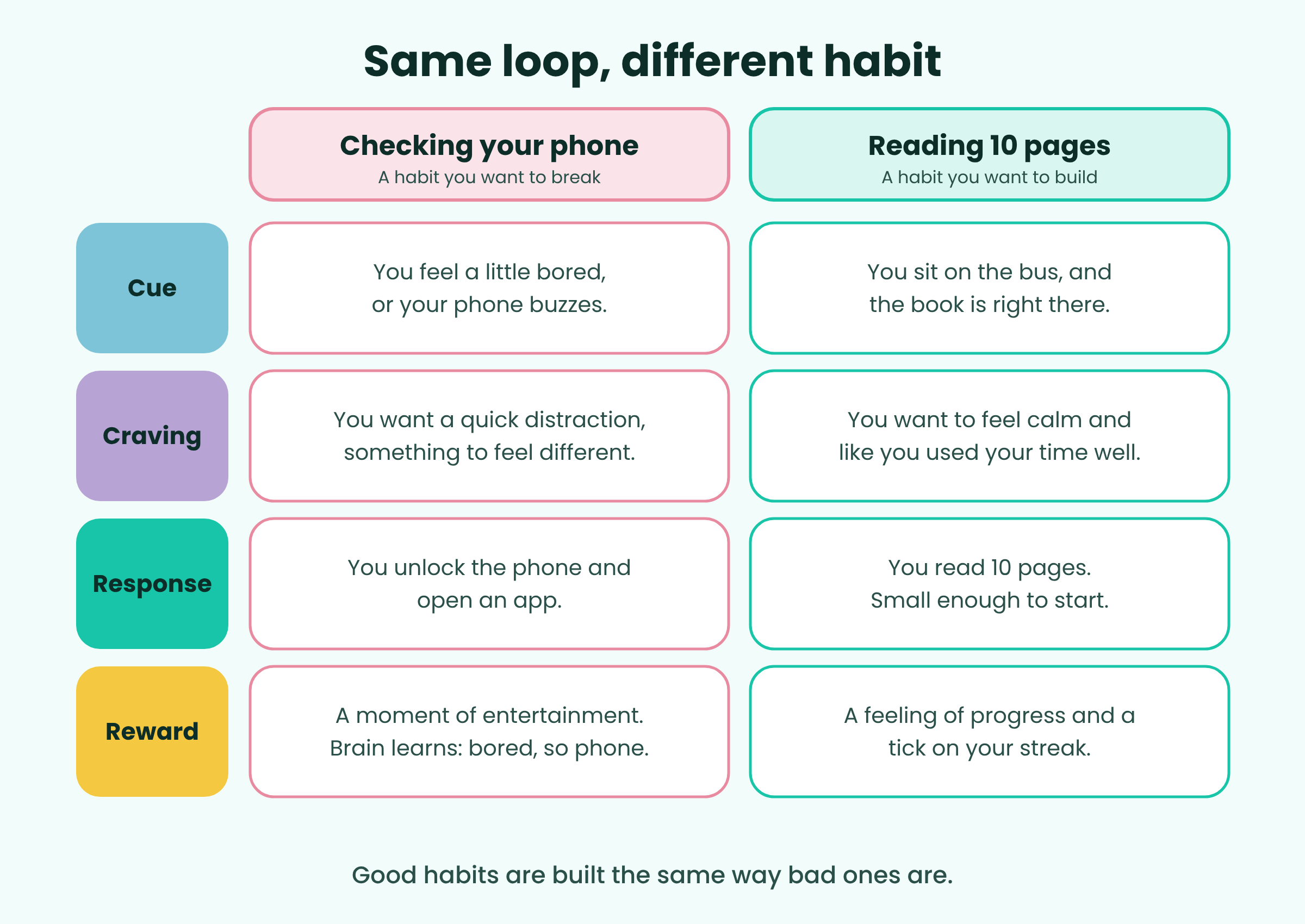
Same loop, different habit. Good habits are built the same way bad ones are.
Why this is useful
If a habit is a loop, you can change it by changing one step. Clear's book turns the four steps into four practical rules: make a good habit obvious, attractive, easy and satisfying, and flip each one to break a bad habit.
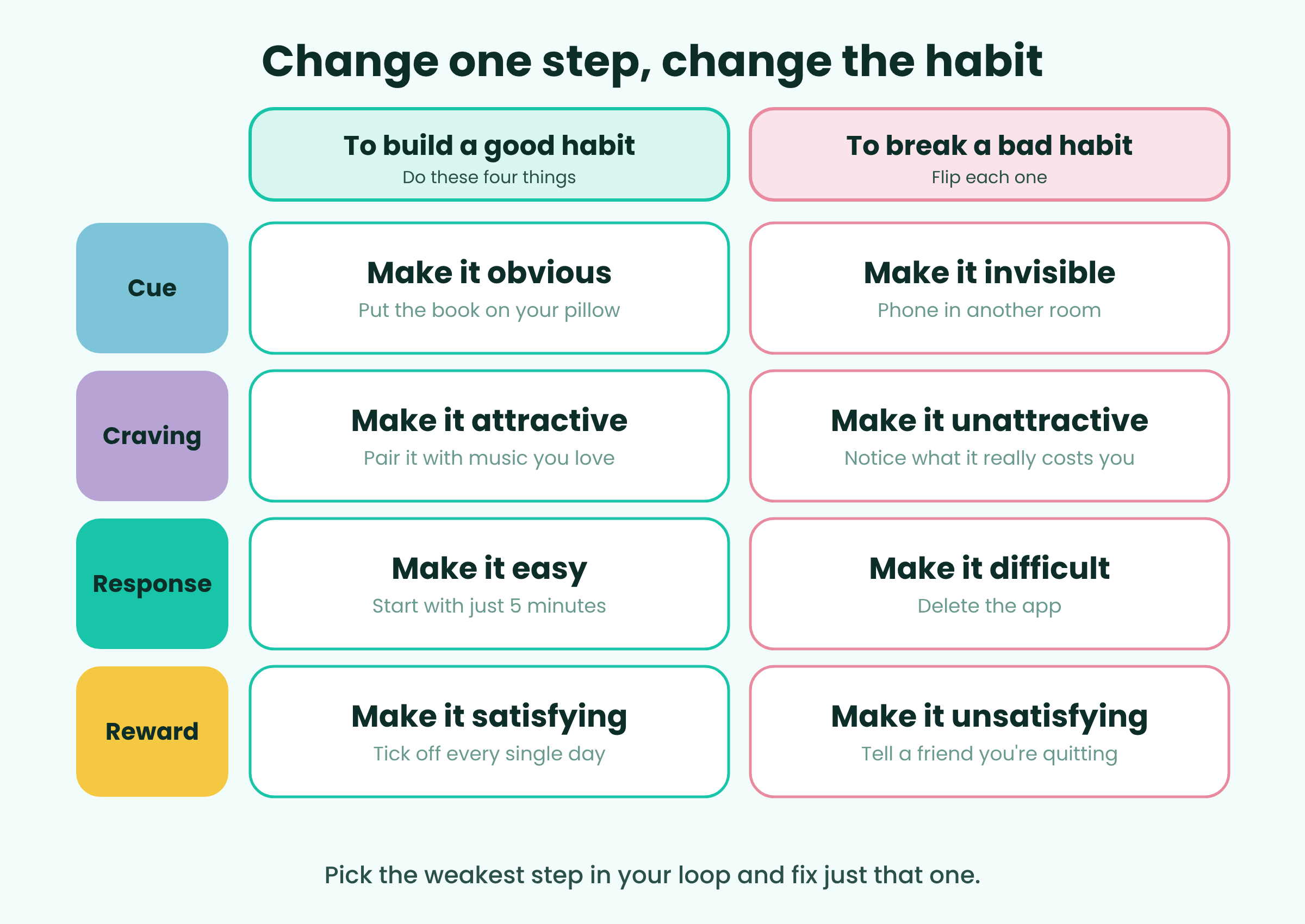
Some simple examples:
- Obvious: Put your book on your pillow, or your water bottle on your desk, so the cue is in front of you.
- Attractive: Pair something you need to do with something you enjoy, like your favourite music during a workout.
- Easy: Shrink the habit. Instead of "work out for an hour," start with 5 minutes or a few push-ups.
- Satisfying: Track it. Ticking off a day gives you an immediate reward, which is what the loop needs.
To cut down on a habit, flip the steps. Put the phone in another room (less obvious), delete the app (harder), or tell a friend you're quitting (less rewarding to fail).
Where a 21-day challenge fits
A challenge like our 21 Days Challenge works because it strengthens the loop, especially the reward. Each daily check-in is a small, immediate win, and the streak gives you something you don't want to break. After a couple of weeks, the cue starts to feel natural and the habit takes less effort to begin.
You don't need to change your whole life. Pick one habit, find its cue, make it small and make it satisfying, and run it through the loop for 21 days.
Try it today
- Choose one habit you want to build.
- Write down its four steps: what's the cue, the craving, the response and the reward?
- Find the weakest step. Is the cue easy to miss? Is the response too big? Is there no reward?
- Fix that one step.
Small change, repeated daily. That's all a habit really is.
References
- Clear, James. Atomic Habits: An Easy & Proven Way to Build Good Habits & Break Bad Ones. Avery, 2018.
- Duhigg, Charles. The Power of Habit: Why We Do What We Do in Life and Business. Random House, 2012.
Day 1 is today.
Pick one thing, tap once a day, and see it through. Free to start, no card needed.