
Design Your Environment to Build Better Habits
Learn how friction, choice architecture, and small environmental changes can make good habits easier to build and unwanted habits harder to repeat over 21 days.
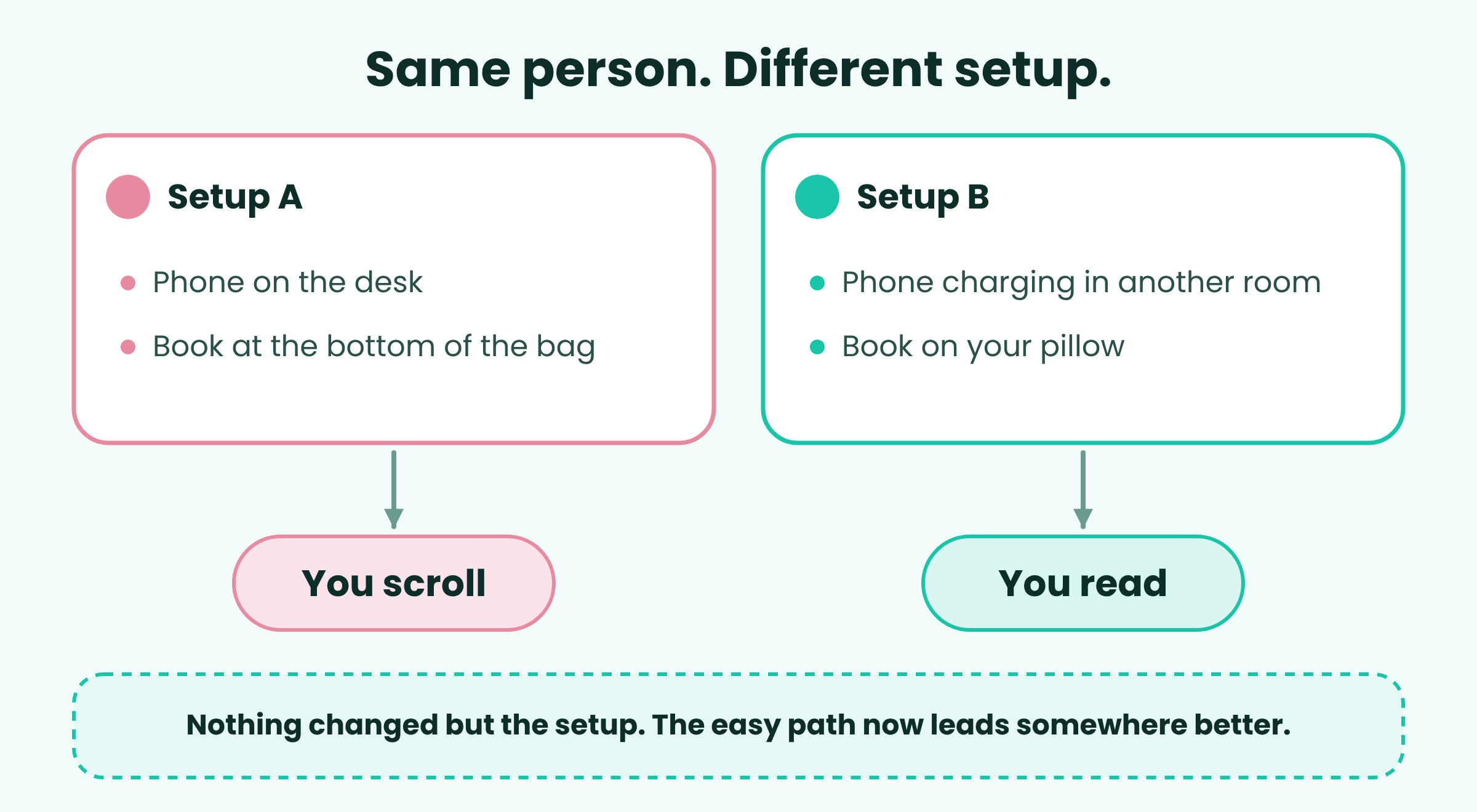
It's 11 PM. You meant to read ten pages, but you're forty minutes into your phone instead. It feels like a willpower failure, but look at the setup: the phone is in your hand, and the book is at the bottom of a bag across the room.
Most of us try to fix our habits by trying harder. A more reliable fix is to change the path in front of you, so the habit you want is easy and the habit you want to break is hard.
What is friction?
Friction is anything that makes an action take more time, effort or thought. Low friction means the action is easy: one tap, nothing to decide. High friction means there are obstacles in the way: extra steps, searching, waiting or deciding.
People tend to drift toward the easiest option. That's why a habit that takes one tap, like opening a social app, so often beats a habit that needs ten minutes of setup, like going for a run. It's also why changing the friction is one of the most dependable ways to influence what you do.
Choice architecture: your setup is never neutral
Economist Richard Thaler and legal scholar Cass Sunstein use the term choice architecture to describe how options are arranged when we make decisions. In their book Nudge, they explain that there is no such thing as a completely neutral layout: something has to be at eye level, something has to be the default, and something has to come first. These small details can quietly shape what people choose.
A cafeteria is a classic example. Foods placed first or at eye level tend to get chosen more often, even though nothing is banned and everything is still available. Workplace savings show the same principle: when employers automatically enrol people, while allowing them to opt out, participation can increase compared with requiring employees to sign up themselves. A nudge changes the setup, not the rules.
You are the architect of your own home, desk and phone. Your surroundings may have been arranged by accident or shaped by the companies behind your apps. You can rearrange them intentionally to support the habits you want.
Count the steps
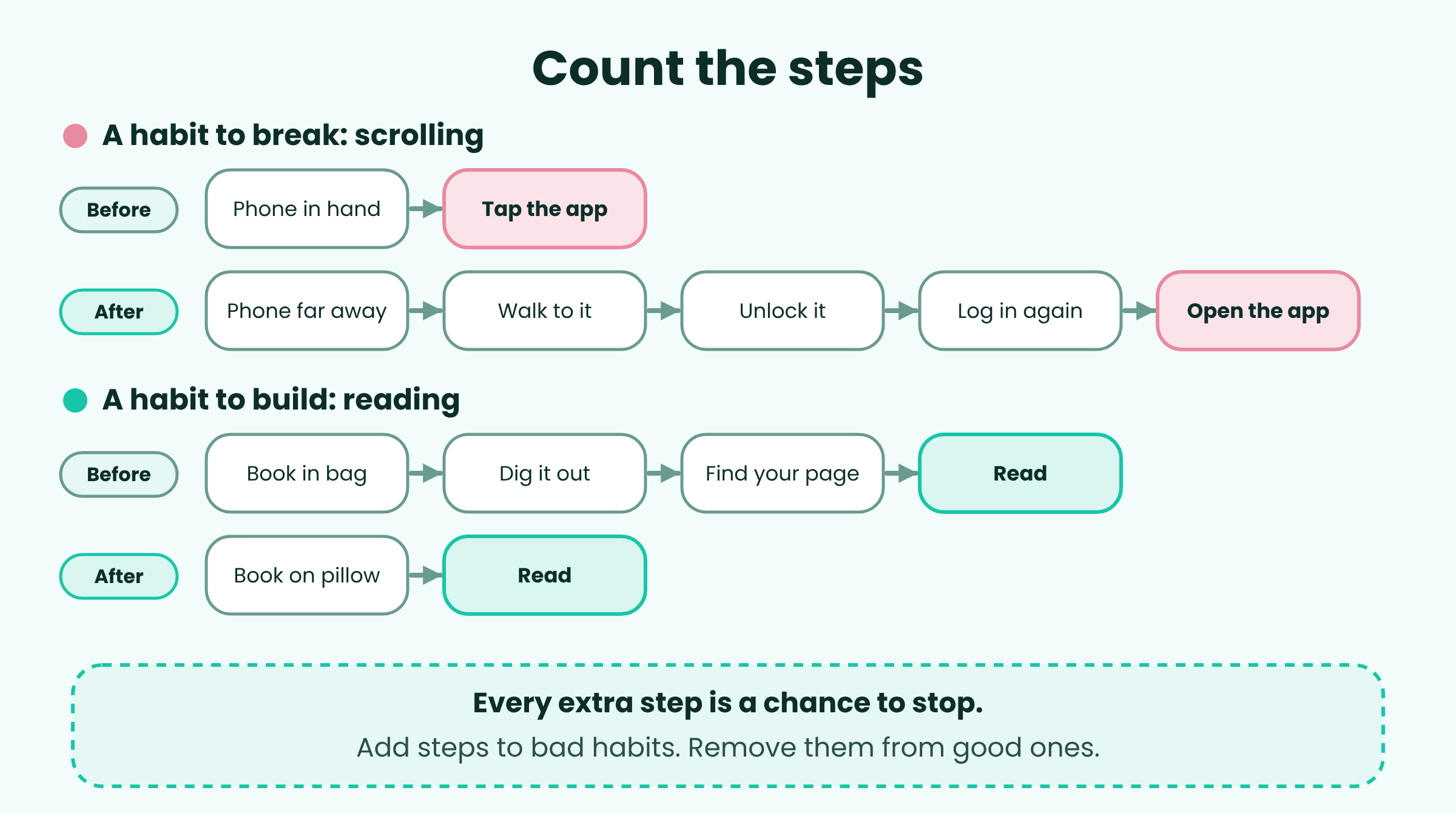
A simple way to understand friction is to count the steps between you and a habit. Scrolling takes very little effort when your phone is already in your hand and the app is on your home screen. If the phone is in another room and you have to walk over, unlock it, log in again and open the app, there are several extra steps, each giving you a chance to reconsider.
Now reverse the situation for a habit you want to build. If your book is buried in a bag, reading requires extra effort. If it's already on your pillow, getting started becomes much easier.
Two levers: add friction, remove friction
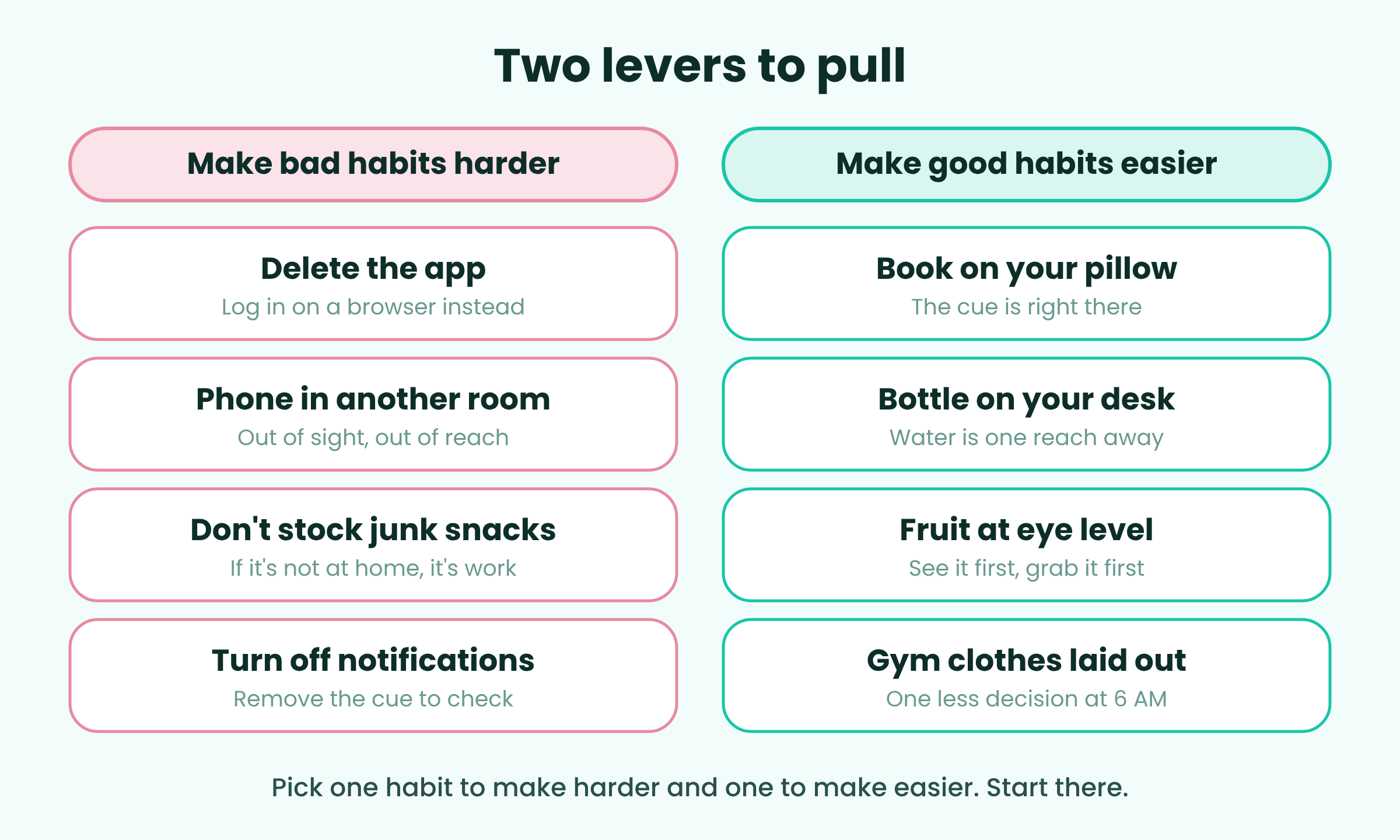
Once you understand friction, you have two practical ways to change your behavior:
James Clear describes a similar principle in Atomic Habits: make unwanted habits invisible and difficult, while making good habits obvious and easy.
Here are a few practical examples:
- Make distractions harder: Log out of distracting apps, move them off your home screen, keep your phone in another room or turn off unnecessary notifications.
- Make healthy choices easier: Keep your book visible, place a water bottle on your desk, put fruit where you can see it and prepare your workout clothes the night before.
- Reduce decision-making: Decide when and where you'll practise a habit in advance instead of figuring it out every day.
The 20-second rule
Author Shawn Achor popularized a practical idea in The Happiness Advantage: reduce the effort required for a habit you want by making it easier to start, and increase the effort required for a habit you want to avoid.
For example, Achor describes moving his guitar out of a closet and onto a stand in his living room so he would be more likely to play it. He also describes making watching television less convenient by removing the batteries from the remote.
These examples illustrate a useful strategy rather than a universal scientific rule. You can experiment with small changes to see which ones make the biggest difference in your own routine.
Your surroundings are the cue
Psychologist Wendy Wood, who has studied habits for decades, explains that habits are strongly connected to context. Places, times of day, people and objects can act as cues that trigger familiar behaviors with little conscious thought.
In a diary study, Wood and her colleagues found that about 43% of everyday behaviors were performed almost daily in the same context. This helps explain why familiar surroundings can make habits feel automatic.
It also explains why a change of surroundings can create an opportunity for change. When people move home or start a new job, old cues may disappear and established routines can become easier to reconsider. Researchers call this habit discontinuity. You don't need to move house to use the same principle: rearranging your desk, changing where you charge your phone or preparing a dedicated reading space can introduce new cues into your routine.
Friction has limits
Friction isn't magic. If you strongly want something, a few extra steps might not stop you, and you can always reinstall an app. Think of friction as a speed bump, not a locked door. It gives you a moment to pause and make a more deliberate choice.
For the best results, pair friction with a replacement habit. If you want to stop scrolling before bed, decide what you'll do instead, such as reading one page or listening to a relaxing audio track. And if you slip, treat it as useful information about your setup rather than a reason to give up.
Where a 21-day challenge fits
Before starting a 21-day challenge, spend ten minutes redesigning your environment. Put your workout gear where you'll see it, move your biggest distraction out of reach and make the first step of your new habit take less than a minute.
When your environment supports your goal, your daily check-in becomes easier. Instead of fighting the same obstacles every day, you create a setup that helps you follow through consistently.
Try it today
- Choose two habits: Pick one habit you want to reduce and one you want to build.
- Count the steps: Notice how much time, effort and decision-making each habit currently requires.
- Add friction: Log out of a distracting app, move your phone to another room or turn off unnecessary notifications.
- Remove friction: Lay out your workout clothes, put your book beside your bed or prepare what you need the night before.
- Observe the results: Pay attention to what changes over the next three days and adjust your setup as needed.
Don't rely on willpower. Redesign the path.
References
- Thaler, Richard H., and Cass R. Sunstein. Nudge: Improving Decisions About Health, Wealth, and Happiness. Yale University Press, 2008.
- Wood, Wendy. Good Habits, Bad Habits: The Science of Making Positive Changes That Stick. Farrar, Straus and Giroux, 2019.
- Achor, Shawn. The Happiness Advantage: The Seven Principles of Positive Psychology That Fuel Success and Performance at Work. Crown Business, 2010.
- Wood, W., Quinn, J. M., & Kashy, D. A. (2002). Habits in everyday life: Thought, emotion, and action. Journal of Personality and Social Psychology, 83(6), 1281–1297.
- Verplanken, B., & Wood, W. (2006). Interventions to break and create consumer habits. Journal of Public Policy & Marketing, 25(1), 90–103.
- Clear, James. Atomic Habits: An Easy & Proven Way to Build Good Habits & Break Bad Ones. Avery, 2018.
Day 1 is today.
Pick one thing, tap once a day, and see it through. Free to start, no card needed.