
Build Better Habits with Tiny Changes
Discover BJ Fogg’s Tiny Habits method and learn how small actions, daily routines, and simple celebrations can help you build lasting habits over 21 day.
You decide to work out for an hour every morning. Day one goes great. By day three you're tired, and by day five the plan has quietly disappeared.
It's easy to blame yourself, but the plan was probably just too big. Stanford behavior scientist BJ Fogg has spent years studying this problem, and his answer is simple: make the habit tiny.
Why big habits fail
Motivation is like the weather. Some days you're full of energy, and other days you can barely get off the sofa. If a habit only works when you feel motivated, it will fail on the bad days, and bad days always come.
Fogg's approach is to stop depending on motivation. Instead, make the habit so small that you can do it even when you don't feel like it.
The Fogg Behavior Model
Fogg explains behavior with a short formula: B = MAP. A behavior (B) happens when three things come together at the same moment:
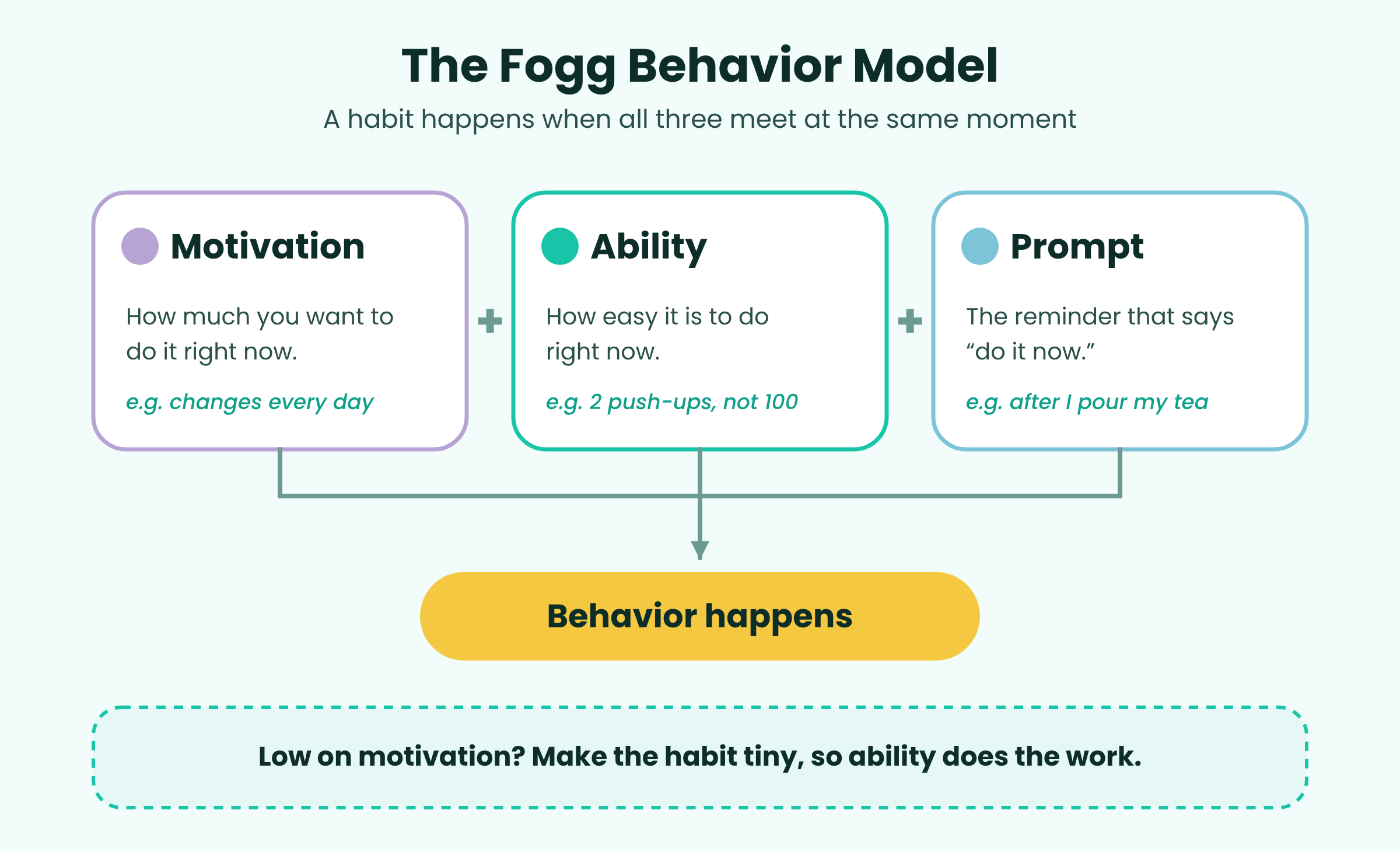
- Motivation: How much you want to do it right now. It changes all the time.
- Ability: How easy it is to do right now. The less time, effort and thinking it takes, the easier the habit becomes.
- Prompt: The reminder that tells you to do it now. Without a prompt, even an easy habit you want to build can be forgotten.
If a habit isn't happening, one of these three elements may be missing. Since motivation is difficult to control, one of the simplest solutions is to increase ability by making the habit easier.
Step 1: Shrink the habit
Take the habit you want to build and shrink it until it feels almost silly. The goal isn't to stay small forever. It's to make starting so easy that you don't need motivation.
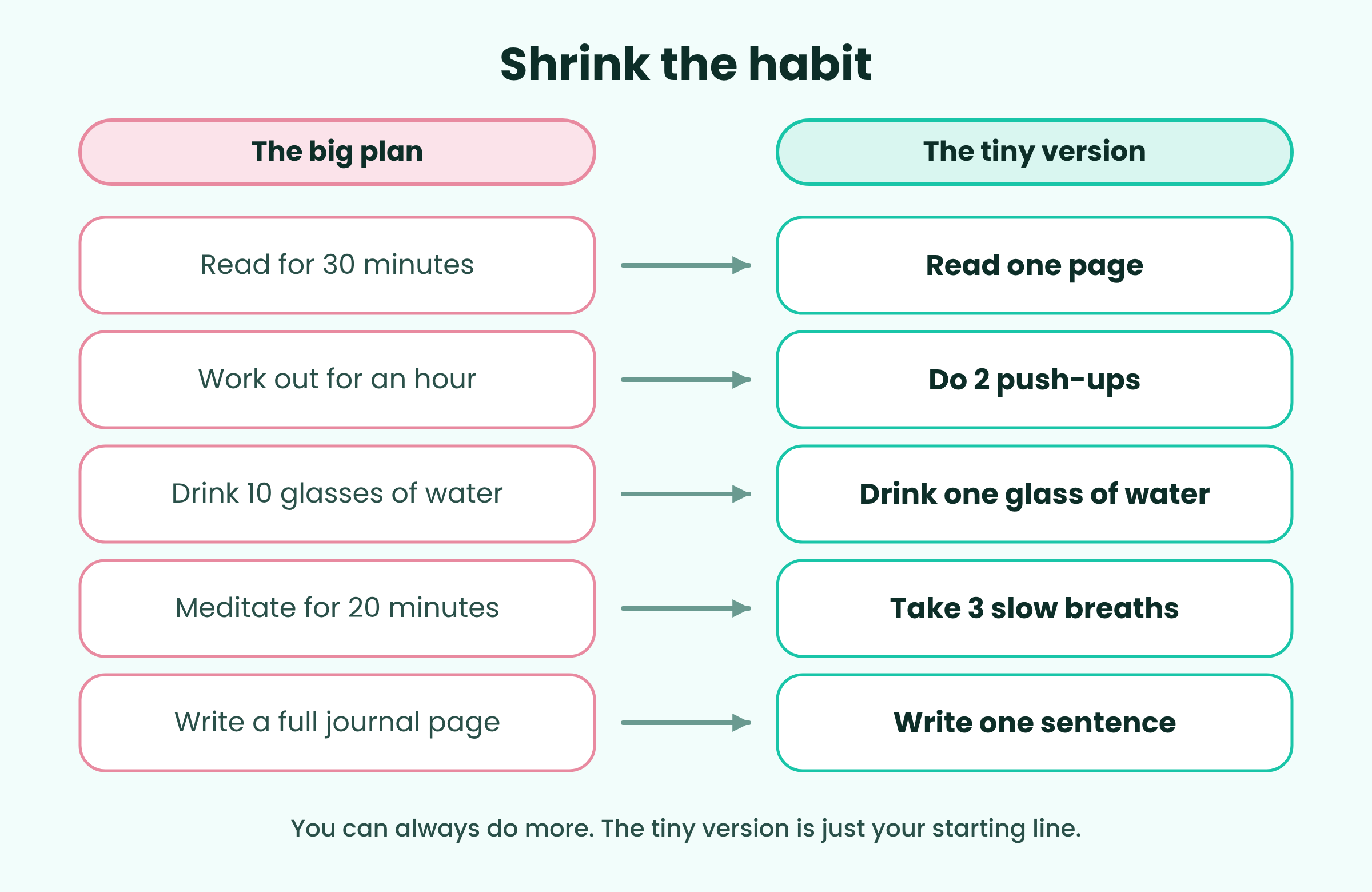
Once the tiny version feels natural, you can gradually grow it. Sometimes it grows on its own: you open a book to read one page and end up reading ten. But even if the habit stays tiny on a difficult day, you still get to practise showing up.
Step 2: Anchor it to something you already do
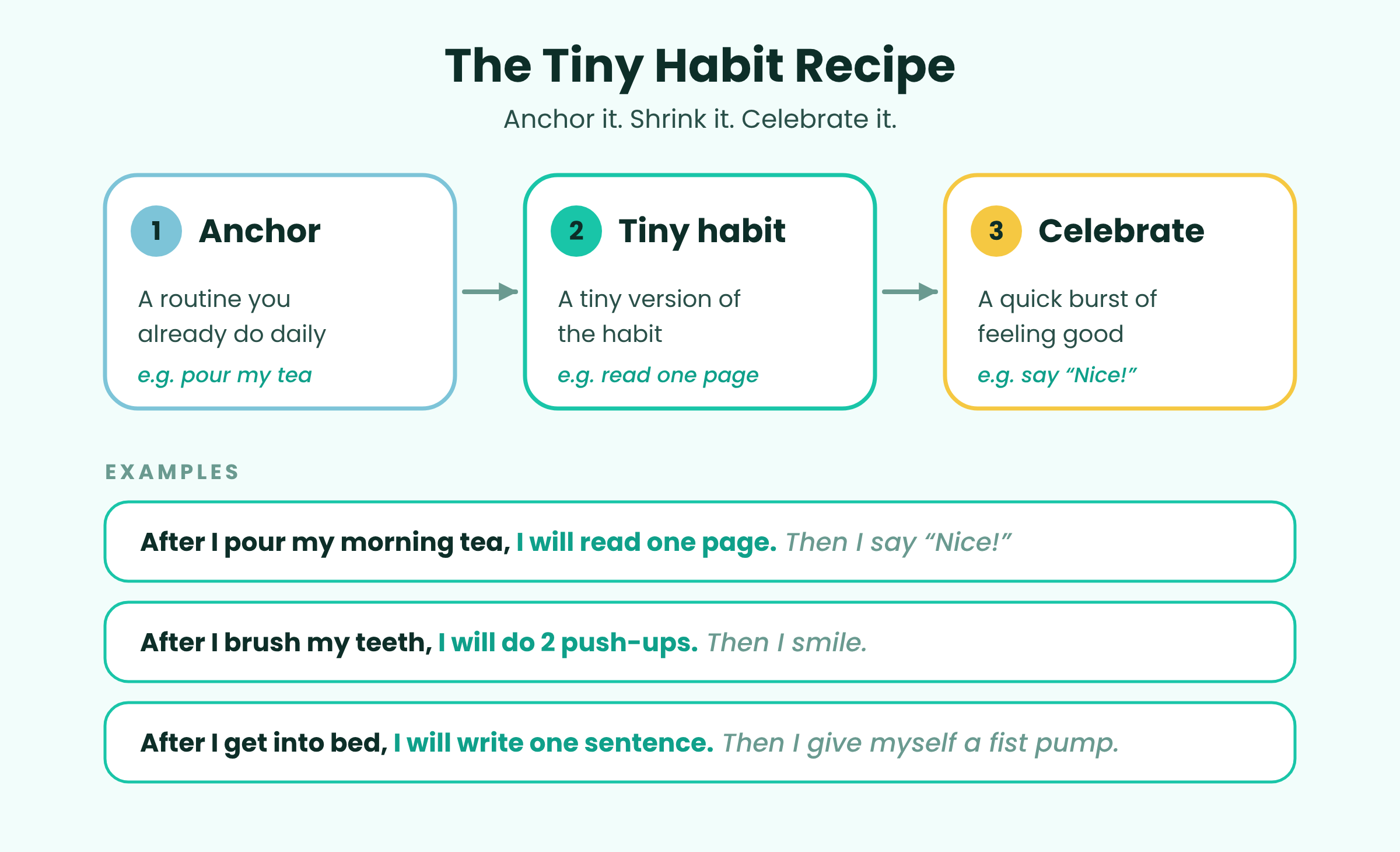
A tiny habit still needs a prompt. One practical approach is to connect it to something you already do every day, which Fogg calls an anchor. It could be pouring your morning tea, brushing your teeth or getting into bed. James Clear describes a similar technique as habit stacking in Atomic Habits.
For example, instead of relying on memory to practise reading, you could say, "After I pour my morning tea, I will read one page."
Step 3: Celebrate straight away
This is the step many people overlook. Right after you finish your tiny habit, celebrate. A smile, a quiet "Yes!" or a fist pump is enough.
Fogg emphasizes that positive emotions can help reinforce new habits. The goal is to make the experience feel good immediately, rather than relying only on long-term rewards or the satisfaction of repeating an action.
Where a 21-day challenge fits
A 21-day challenge is a practical way to practise this method. Choose one tiny habit, connect it to an existing routine, and check in every day for 21 days. Each check-in gives you a chance to recognize your progress, while tracking your streak can provide an extra reason to keep going.
The key is choosing a version so small that you can complete it even on your worst day. That makes it easier to keep practising when motivation drops and life gets busy.
Try it today
- Pick one habit: Choose something you genuinely want to do more consistently.
- Make it tiny: Shrink it until it takes less than a minute and requires very little effort.
- Choose an anchor: Connect it to something you already do every day.
- Write your plan: Complete the sentence, "After I ___, I will ___."
- Celebrate immediately: Give yourself a small moment of positive recognition after completing the habit.
Start so small it feels silly. Then show up every day.
References
- Fogg, B. J. Tiny Habits: The Small Changes That Change Everything. Houghton Mifflin Harcourt, 2020.
- Clear, James. Atomic Habits: An Easy & Proven Way to Build Good Habits & Break Bad Ones. Avery, 2018.
Day 1 is today.
Pick one thing, tap once a day, and see it through. Free to start, no card needed.